Using visual prompts like the ones included in the free printable below is a great way to support self-regulation skills in kids!

This post contains affiliate links. Read more.
Self-regulation refers to a child’s ability to manage their arousal, behavior, emotions, attention, and motor output so they can engage appropriately in a given situation. Self-regulation involves a complex mix of cognition, sensory systems, motor control, and behavior. That means when a child is dysregulated, whether due to anxiety, a tantrum, a rough transition, separation worries, anger, or sadness – their brain and body are out of sync. It’s like their “regulation engine” is stalled, and the skills they can usually access (attention, impulse control, motor planning) are harder to tap into.
When kids hit a moment of dysregulation (anxiety, meltdown, confusion, overwhelm), they often can’t “just calm down.” Their nervous system is highly activated; their sensory and emotional systems are too overloaded. That’s where visual supports come in. Visuals provide a concrete, accessible tool when a child’s internal systems feel chaotic. They help reduce cognitive load (less verbal explanation needed), offer step-by-step cues, and anchor attention to something outside the storm.
When Visuals Are a Game-Changer
Visual supports can serve as a bridge between a dysregulated moment and a regulated state. Visuals help because they:
-Provide structure without relying solely on verbal processing (which may be impaired during dysregulation)
-Offer predictable cues (kids know what’s coming) which reduces anxiety
-Support co-regulation: when an adult uses the visual tool alongside the child, it builds connection & regulation together. See the post What is Co-Regulation? for more info on co-regulation strategies.
-Serve as immediate, concrete tools for self-soothing or resetting body and brain.
Self-Regulation Resets
That brings us to our latest resource, 10-Step Self-Regulation Resets. The inspiration for this idea came from a resource in a book called, CBT Toolbox for Children and Adolescents: Over 200 Worksheets & Exercises for Trauma, ADHD, Autism, Anxiety, Depression & Conduct Disorders. The grounding exercise in this book is a great way to help kids work through challenging emotions like anxiety, anger, sadness, etc.
And now, you can get one of these self-regulation resets in a completely interactive format (and it’s FREE!). Check out our Self-Regulation Spinner!
While we found the exercise to be extremely effective with kids, we found that we needed to adapt it to suit the needs of kids who required:
-More visual support and less verbal
-More specific activities to help them ground and calm themselves
-More hands-on, sensory-based, whole-body, and movement-based activities to help them calm their nervous systems
-Novel and creative activities to grab their attention and get them to engage
Because of this, we created a series of 4 visual prompt pages that include 10 short, concrete, sensory/movement-based micro-tasks – the kind that can be done quietly, without a lot of prompting, and that feel a bit playful but still purposefully grounding and calming.
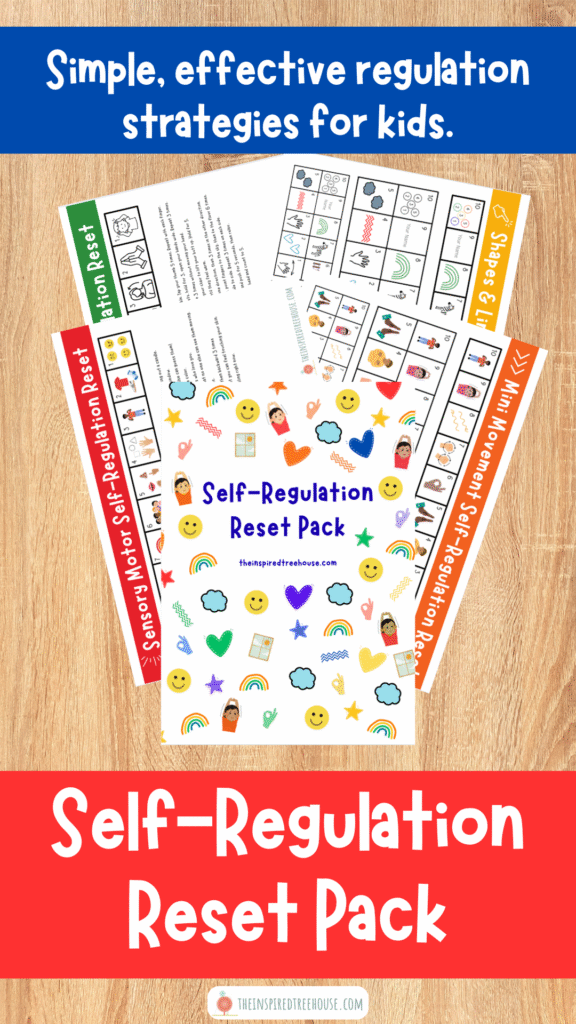
The Self-Regulation Reset Pack
You can get a FREE Printable 10-Step Regulation Reset by filling out the form below. But for the full effect, you’ll want our Self-Regulation Reset Pack.
Includes: 4 printable self-regulation sequences with 3 printable options for each AND Google Slide presentations for each sequence that can be used on your Smart board, your tablet, or on your mobile device on-the-go!
What is a Self-Regulation Reset?
Each of our Self-Regulation Reset visuals includes a sequence of 10 simple and subtle tasks or activities kids can do to help them calm their bodies and minds. These include sensory, movement, mindfulness, or awareness tasks that kids can engage in almost anywhere.
The tasks are not loud or distracting and they can be done one-on-one, in a small group, or in a large group setting like a classroom.
How to Use the Self-Regulation Reset Visuals
Here are practical ideas for how to use these visuals in the classroom, therapy room, or at home!
These Self-Regulation Resets are perfect to use:
-When you see that a child is starting to become dysregulated
-When you know that a transition, activity, or part of the routine that typically triggers dysregulation is coming
-After a meltdown, when you have helped the child regulate and need a way to reset and transition back into the daily routine
-When a child is anxious about a certain experience or situation (e.g. separating from a caregiver, storms, etc.)
Where to keep them:
-Laminate and cut out the first strip to secure to the child’s desk, to the therapy table, or to a folder/binder.
-Laminate and cut out the second set of pictures for use in the classroom, in the therapy room, to keep in your purse, or to keep in the car.
-Laminate and cut out the third smaller set of pictures. Punch a hole in the corner and wear on your lanyard for easy access.
-Laminate the instructions onto the back of the pictures as a reminder for what to do during each step.
How to use them:
-Tape the strips to the desks of everyone in your class for an easy way to reset the energy of the room after a transition (e.g. after lunch or recess)
-Use the reset on your lanyard as a way to keep kids occupied when waiting in line for the bathroom, gym, art room, lunch room, etc.
-Move through the activities as an introduction to your therapy session or classroom lesson.
-Use with kids before or during high stress or overstimulating outings/situations.
-Place the reset card in your calm-down corner with other calming activities like our calming breathing cards or our hallway waiting games.
-Laminate the pictures, cut on the lines so each picture is on its own card, and place velcro on the back of each picture. Let kids create their own reset sequence by arranging the pictures in their own unique sequence on a velcro board.
-Most children will need initial facilitation to learn how to perform the sequence
-Regular use of the visuals can be with adult facilitation (this can be a great co-regulation tool to build connection and trust with the child) OR the child can use the sequence independently once they learn it.
Visuals + Sensory Input = Powerful Regulation
It’s not enough to simply show a visual cue to a child and hope things change. The most effective tools combine a visual prompt + sensory experience + adult support (co-regulation). According to the self-regulation research overview, movement-based interventions (like yoga, heavy work, sensory play) help kids build self-control, attention, and emotional stability. Visuals act as the “map” and movement is the “engine.” Our Self-Regulation Handbook is filled with movement games, visuals, and strategies for exactly this reason: you cannot separate the brain from the body when it comes to regulation.
Visual supports are not a fancy add-on, they’re a lifeline for kids whose internal regulation engine is overwhelmed. By giving children a visual map they can follow when feelings, transitions, or sensory input feels out of control, we help them move from chaos to calm.
KEY TAKEAWAY: The goal of these visuals and simple reset sequences is to teach kids a strategy that they can memorize and use for the rest of their lives to help regain regulation and calm their bodies and their minds. Side note…this works for adults too!
Let’s give kids the tools they need, not just to survive moments of dysregulation in childhood, but to be confident that they can find their way to peace and calm throughout their lives!
Resources
In early childhood and elementary years especially, research shows that self-regulation supports school readiness, attention, social-emotional development, overall academic skills and life success. Our post, Self-Regulation Research: A Simple Overview explains that children who develop stronger self-regulation skills tend to fare better in the classroom, within peer relationships, and with impulsivity control.
Recognizing red flags like difficulty with waiting, transitioning, or staying in line is also vital. Our post on Behavior & Self-Regulation Red Flags outlines signs to watch for so we can intervene early.
The Self-Regulation Handbook: Pro tips, expert strategies, & tried-and-true tools to support self-regulation so kids can learn, grow, & succeed!