Visual timers for kids are one of the most effective tools for parents and professionals to support transitions and prevent challenging behaviors.

Why Visual Timers Are a Game-Changer for Kids Who Struggle With Transitions
No doubt about it, transitions can be tough for kids. Whether it’s switching over from playtime to mealtime, turning off the TV, packing up to leave the house, or shifting between subjects at school, transitions are part of everyday life. And for many kids—especially those with developmental differences, sensory sensitivities, or executive functioning challenges—transitions can be a real source of stress, anxiety, or even full-blown meltdowns.
As adults, we’re constantly shifting our attention and adjusting to new tasks throughout the day. It’s something that we may take for granted. But we need to remember that this is a skill that many kids need to be taught and may need support with. Their developing brains don’t yet have all the tools needed to switch gears easily. They may become upset when their favorite activity ends, have difficulty understanding the concept of time, or feel overwhelmed when routines change unexpectedly. What looks like defiance or “bad behavior” during transitions is often just a child who’s lacking the skills, language, or regulation needed to cope with the change.
So what can we do to help?
Enter the visual timer.
Visual timers for kids are one of the most effective tools we use as pediatric therapists to help kids get a better grasp on the passage of time. Instead of relying solely on verbal reminders (“5 more minutes!”), visual timers for kids provide a concrete, predictable way to show time—and they can make all the difference in helping kids feel more secure, more in control, and better prepared for what’s coming next.
Whether you’re a parent trying to get your child out the door in the morning, a teacher managing transitions between classroom activities, or a therapist supporting emotional regulation, a visual timer can reduce power struggles, ease anxiety, and give kids the support they need to build independence.
Grab the free printable handout below!
Timers are an amazing tool for transitions. But what do you do when you have an awkward few minutes left in your therapy session, or when you’re running a bit early for the transition to your next activity? Check out these quick, skill-boosting filler activities!
Why Transitions Are So Hard for Kids
Before we dive deeper into how visual timers work, it’s important to understand why transitions can be such a challenge in the first place.
Difficulty Understanding Time: Young children and neurodivergent kids often don’t have a clear grasp of how long a minute or 10 minutes really is. Telling a child “You have 5 more minutes” doesn’t mean much if they don’t understand what that looks or feels like. Time is abstract—visual timers make it concrete.
Executive Functioning Concerns: Skills like planning, shifting attention, and self-monitoring fall under the scope of executive functioning, which is still developing well into adolescence. Transitions require kids to stop one task, switch their attention, and prepare for what’s next—all of which can feel overwhelming without support.
Emotional Regulation Issues: Transitions can feel abrupt and often lead to intense feelings, especially if a child is doing something they enjoy. Without strategies to process or regulate those emotions, transitions can trigger outbursts, shutdowns, or refusals.
Not Knowing What to Expect: Many children (especially those with autism or anxiety) feel safest when they know what to expect. Transitions without warning or structure can feel chaotic or even scary. Visual timers help add a layer of predictability that builds trust and security.
Why Visual Timers Work
Like visual schedules, visual timers for kids work because they reduce uncertainty. They give kids clear, concrete information about how much time they have, which supports:
✅ Independence – Kids don’t need to ask over and over, “How much longer?” and we don’t need to give as many verbal cues.
✅ Emotional Regulation – Seeing time pass gives kids a chance to mentally and emotionally prepare for the end of an activity.
✅ Predictability – Timers become part of the routine and reduce the fear of the unknown.
✅ Visual Cue – The visual cue helps shift attention more effectively than words alone.
✅ Improved Focus – Knowing how long an activity will last can help kids stay engaged longer, because the end point is clear.
And let’s be honest—timers can help parents and professionals too! They reduce the need for repeated reminders or countdowns and provide a neutral third party (“the timer says it’s time”) that removes some of the emotional load from you.
Our Favorite Visual Timers for Kids
Some of our favorite visual timers for kids are apps. Why? Because we always have our phones with us and having a few timer apps downloaded means that you will have one on hand whenever you need it! Here are our faves:
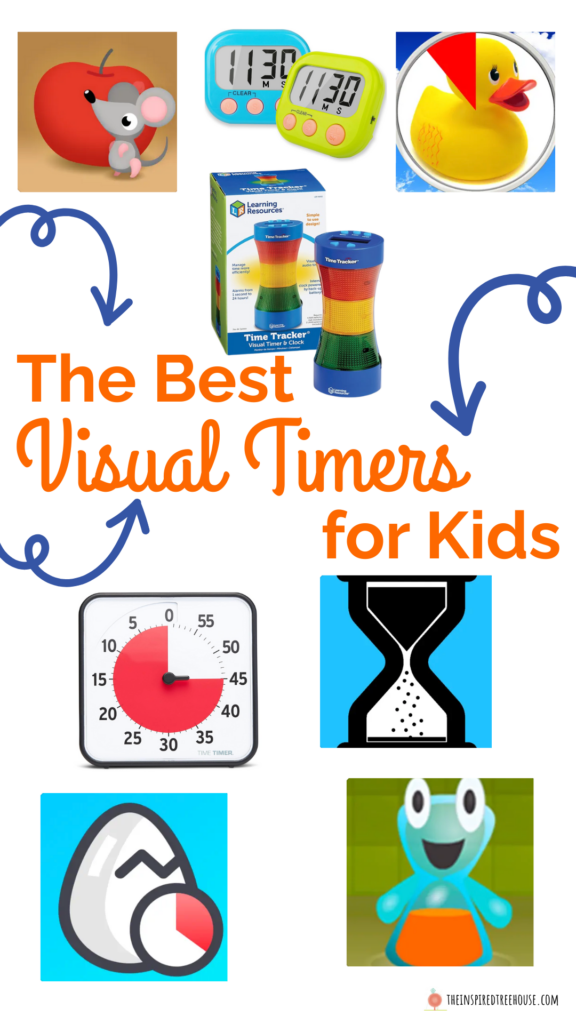
Mouse Timer App
This is by far our Treehouse kids’ favorite timer. We use it every single day (multiple times a day). The kids love being in charge of pushing the button for the designated number of minutes and then watching as the mouse eats all of the apples on the screen until he gets to the cheese and the timer rings!
Children’s Countdown Timer App
Another favorite of ours. This timer has a picture of an object hidden in the middle of it and, as the time ticks down, more of the picture is revealed so the kids can try to guess what it is! It makes the passage of time exciting and positive as the kids look forward to seeing the image!
Lickety Split App
This app has two different modes: Beat the Timer and Countdown. For the Beat the Timer version, you can choose a task (getting ready to go, making your bed, getting dressed, etc.) and then the child tries to complete the activity before the timer rings! If they do, they get a little on-screen celebration and prize! You can also choose a Beat the Timer clock by how many minutes you want. For the Countdown version, you can choose different tasks like brushing your teeth, reading, studying, or taking turns. The timer gets set and the child does the task until the timer rings. This app has cute graphics and sounds that kids will enjoy!
Sandy Timer App
This is the timer for all of your visual sensory kiddos! Set it for as much or as little time as you want and watch the multi-colored beads fall through the sand timer on the screen. It’s mesmerizing and simple!
Little Timer Hatch Countdown App
Similar to the Children’s Countdown Timer App, this one has a hidden picture behind an egg. When the timer rings, the egg cracks open to reveal the picture. The picture is animated with music! You can use the free version or upgrade to get more pictures!
Classic Visual Timer
This is the classic tabletop visual timer that you’ll often see in classrooms and therapy rooms. It’s simple and straightforward, showing kids a visual representation of how much time is left.
Learning Resources Time Tracker
This one adds a little more interest with lights and sounds to help kids keep track of time.
Digital Timer
And this is a simple digital timer that’s great for teachers and therapists who are on the go. You can throw it in your bag and have it ready any time!
Looking for more support with transitions?
Learn more about calming strategies for transitions.
Check out these resources about how to create visual schedules and why visual schedules work!
Find all of our strategies for managing challenging behavior.